Where are you located?
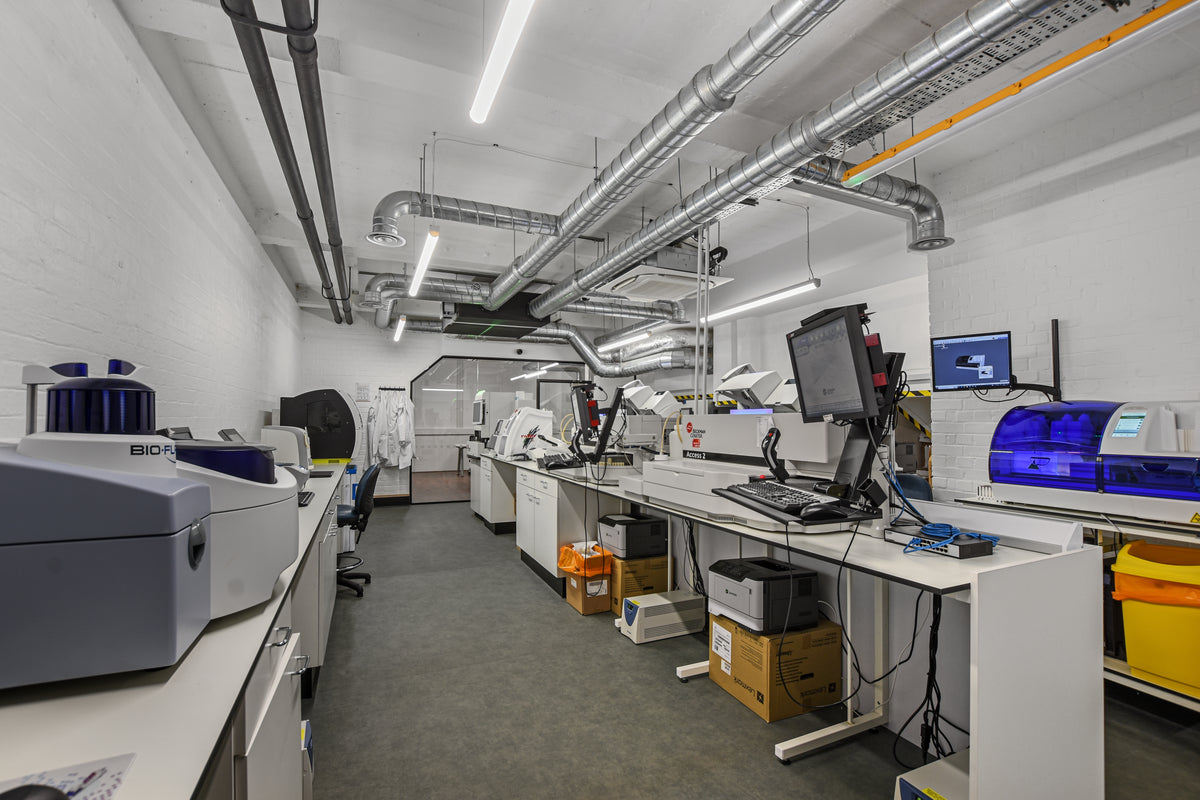
Our flagship clinic and laboratory are at 41–42 Foley Street, Fitzrovia, London W1W 7TS, a few minutes' walk from Oxford Circus (Central, Victoria and Bakerloo lines), Warren Street (Victoria and Northern), Goodge Street (Northern), Tottenham Court Road (Central and Elizabeth) and Great Portland Street (Circle, Metropolitan and Hammersmith & City).
How will I receive my results?
All results will be sent out by email. Please ensure you have provided us with the best email to reach you on.
How do I prepare for my test?
In most cases, there is no preparation needed.
With particular tests, we recommend fasting for 8-10 hours ahead. These tests include glucose, cholesterol/lipid profile and homocysteine. In the event that it is difficult for you to fast, this will be noted by the phlebotomist, and where applicable adjusted reference ranges applied. If you are unsure whether you need to fast, please confirm.
How can I contact Clinilabs?
For all patient enquiries you can contact the reception by phone/whatsapp on 020 4525 8805 or via email: info@clinilabs.co.uk.
For careers at Clinilabs please email careers@clinilabs.co.uk
Do you work with the NHS?
We are a private laboratory, and do not currently offer NHS services.
Can I speak with a doctor about my results?
We can provide written clinical interpretations and/or virtual/in person consultations for your results. These are additional services and are not included in the price of your tests. Please enquire if you are interested in these services.
The price of the tests includes a report that you will receive by email which includes your results as well as (where applicable) reference ranges and indications whether you fall outside of these.
How long will my results take?
At Clinilabs we do our best to give your results to you as soon as possible. Each test has an estimated turnaround time which can be found on each test’s page on our website. Please note that these are estimates and whilst we typically provide results sooner than advertised, we may in some cases require more time. If you are unsure about the turnaround time of your specific test and or require tests urgently, please confirm ahead of your visit.
Do you accept insurance?
We do partner with medical insurance providers such as Bupa UK, Bupa Global, Allianz, Cigna, WPA, Vitality. Please note that pre-authorisation is required for payment by insurance. We will also require payment card details to be kept on file; which will only be used in the event your insurance company does not cover your treatment. Please note that prices can vary greatly between insurance companies, and promotional online-only prices may not reflect prices charged if direct billing is being undertaken.
What is a panel/profile?
A panel (or profile) is a group of single tests chosen together to answer one question, such as iron status, thyroid function or a general health check. Booking the panel is cheaper than booking each marker separately, and the markers are reported together so they can be read in context. Each panel's page lists exactly what it includes.
I'm not sure which test I need?
If you are unsure which test you need, we recommend taking a look at some of our packages. Our website is divided by section and our clinical team have designed a number of panels to suit the most common requests. If still unsure, pleas feel free to contact us by whatsapp/phone/email for guidance. Ultimately, while our team may advise on our offerings, we recommend checking with your doctor as the ultimate responsibility is on the customer to select their tests.
Do I need to fast before my test?
Some blood tests require fasting, but many do not. For example, glucose, cholesterol/lipid profile and homocysteine are among some of the tests needed to fast between 8 - 12 hours. If fasting is required, we recommend doing so overnight and scheduling your appointment for the morning. This helps minimise discomfort from going without food. During the fasting period, you should stay well-hydrated, water is ideal, and you may also have clear, calorie-free fluids such as black tea or black coffee (without milk or sugar).
If you are on medication, please check with your referring doctor if you need to fast. If you are self-referring, then you can call us to find out our recommendation.
Please note: If you are unable to fast, this will be noted and adjusted reference ranges applied.
Why are my Clinilabs blood test results different from my other blood test results?
It’s completely normal to see slight differences in blood test results between different laboratories. These variations can occur for several reasons:
Analytical variation: Even when the same sample is tested multiple times on the same machine, small differences can occur. This is called analytical variation and is measured using the coefficient of variation (CV). For example, total cholesterol has a typical CV of around 3% at a level of 5.0 mmol/L, meaning results between 4.85 and 5.15 mmol/L are entirely expected and not clinically significant.
Test-specific variability: Some tests, especially hormone tests, naturally show more variation. These tests can have CVs ranging from 3% to 10%, so minor result changes are common and generally not a cause for concern.
Laboratory differences: Each lab may use different analysers, reference ranges, or testing methods. Even factors like sample type, collection time, and processing date can lead to slight result differences.
Biological variation: Your body’s own levels can fluctuate throughout the day due to stress, sleep, meals, or hormonal cycles. These natural changes can influence your test results as well.
Can I collect my blood sample at home?
A home finger-prick kit may be self-collected where the selected blood test is suitable for capillary sampling. Follow the kit instructions carefully, because not every test can use a finger-prick sample.
A venous blood draw must not be self-collected: it must be performed by a qualified healthcare professional who is trained and competent in phlebotomy. You can arrange this at a Clinilabs partner clinic or, where offered, as a home visit.
Can my child come to Clinilabs?
At this point in time you must be over 16 to attend Clinilabs. We may however be able to arrange pediatric home visits for children. This is subject to availability. Please enquire with reception if you are interested in this.
Do I need a doctor's referral?
For the majority of tests you do not need to have a referral, but you do need to know which test or set of tests you will need to have. Whilst we can (when possible) help to explain tests available, it is the patient’s responsibility to select the correct test/s, if requested by their doctor. For some specialist tests, you may require a doctors referral. This will be communicated to you upon enquiry.
How do I book an appointment at a partner clinic?
Order your test online and choose the partner clinic option at checkout. We then post you a collection kit, and inside it is a unique booking code. Once the kit has arrived, go to clinics.clinilabs.co.uk, enter the code and choose a clinic and time that suit you. You cannot book before the kit arrives, because the code is needed to make the booking. Take the kit with you to the appointment. After your sample is taken, you post it back to our laboratory yourself using the pre-paid label in the kit.